
April 06, 2004

» An art show inspired by and created via obsessive-compulsive behaviour

It could be argued that all forms of artmaking contain an element of obsession; it drives the will to create and underlies most great works. Though most artists accept their obsession as a means to an end, there are some who explore the nature of obsession, itself, and the statements that an obsessive act can make.

In response to the variety of options that have become available, many artists have narrowed their focus to very limited parameters to explore a singular goal. To the observer, this can be viewed as "obsessive", especially in a culture that glorifies the opposite of obsession — distraction.
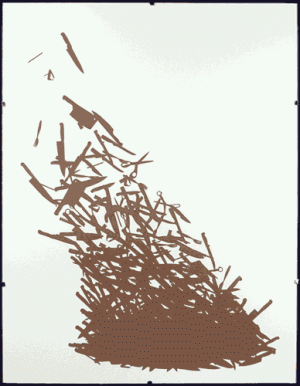
Untitled by Morgan Phalen

» Can a computer prove a mathematical conjecture?

Dr. Hales's proof of the problem, known as the Kepler Conjecture, hinges on a complex series of computer calculations, too many and too tedious for mathematicians reviewing his paper to check by hand.

Believing it thus, at some level, requires faith that the computer performed the calculations flawlessly, without any programming bugs. For a field that trades in dispassionate logic and supposedly unambiguous truths and falsehoods, that is an uncomfortably gray in-between.

Because of the ambiguities, the journal, the prestigious Annals of Mathematics, has decided to publish only the theoretical parts of the proof, which have been checked in the traditional manner. A more specialized journal, Discrete and Computational Geometry, will publish the computer sections.

» The terrible twos really are terrible

The "terrible 2s" are worse than we knew. Research is showing that for almost every little boy (or girl) such as Maxim, not even a rocky adolescence will come as close to the rapid-fire tantrums of the toddler years.

Researchers argue that society must stop excusing aggression in early childhood. Ignoring the problem could mean a child's path is set irrevocably toward delinquency, dropping out of school, and crime. Intervention, it seems, needs to come sooner than ever. If aggressive children don't learn to control their anger early, they might never learn at all.

The idea requires adults to face the worst of human nature in their own children -- that bad things can come in small packages. It goes straight to the age-old debate about the origins of evil: Are human beings born pure, as Rousseau argued, and tainted by the world around them? Or do babies arrive bad, as St. Augustine wrote, and learn, for their own good, how to behave in society?

Richard Tremblay, an affable researcher at the University of Montreal who is considered one of the world leaders in aggression studies, sides with St. Augustine ...